Viewing entries tagged
activism

Who Feeds Us?

Who Feeds Us?

This Spring, Farming The Future launched a Coronavirus emergency response fund: a collaboration between The A Team Foundation, the Roddick Foundation, Thirty Percy and the Samworth Foundation, offering financial support for initiatives that rose to meet the immediate crisis whilst building longer-term resilience. One of the those to receive funding was the award-winning podcast, Farmerama, for a new series called ‘Who Feeds Us?’ A collection of stories about some of the people who produce our food, the 6-part series explores what it takes to feed and nourish communities in the time of a pandemic. The experiences of growers, suppliers, academics, activists, authors and chefs, offers insight into how food that is nourishing for people and the planet might be made accessible to all. The podcast is produced by Jo Barratt, Abby Rose, and Katie Revell, with a team of 23 people, brought together by advisor Dee Woods. Illustrations by Hannah Grace


Ep-1-scaled.jpg

Who feeds us? Episode #1: The Hungry Gap

Whilst the UK went into lockdown this March, supermarket shelves stood empty and many people began to question how we might feed ourselves. The idea of localised food systems went from being a distant dream to a substantial means of sustenance for many people across the country. So, who and what made up those localised food systems? Where did this sudden burst of community provision come from?

Episode #1 covers many corners of the food system, from those supplying high-end restaurants to those on the frontline of emergency food responses. Talking about how their relationships within the industry and community helped them to face new and existing challenges, we hear from farmerJane Scotter and chef, Skye Gyngell; from Angus Buchanan-Smith in Scotland, who grew his farm-to-table restaurant into a CSA scheme and education project; from two London beekeepersSalma and Khalil Attan, who divulge some of the benefits of lockdown for bees; and from Ursula Myrie, founder of Sheffield community food project - the Food Pharmacy.


Ep-2-scaled.jpg

Who Feeds Us? #2: Land, Animal, Journey

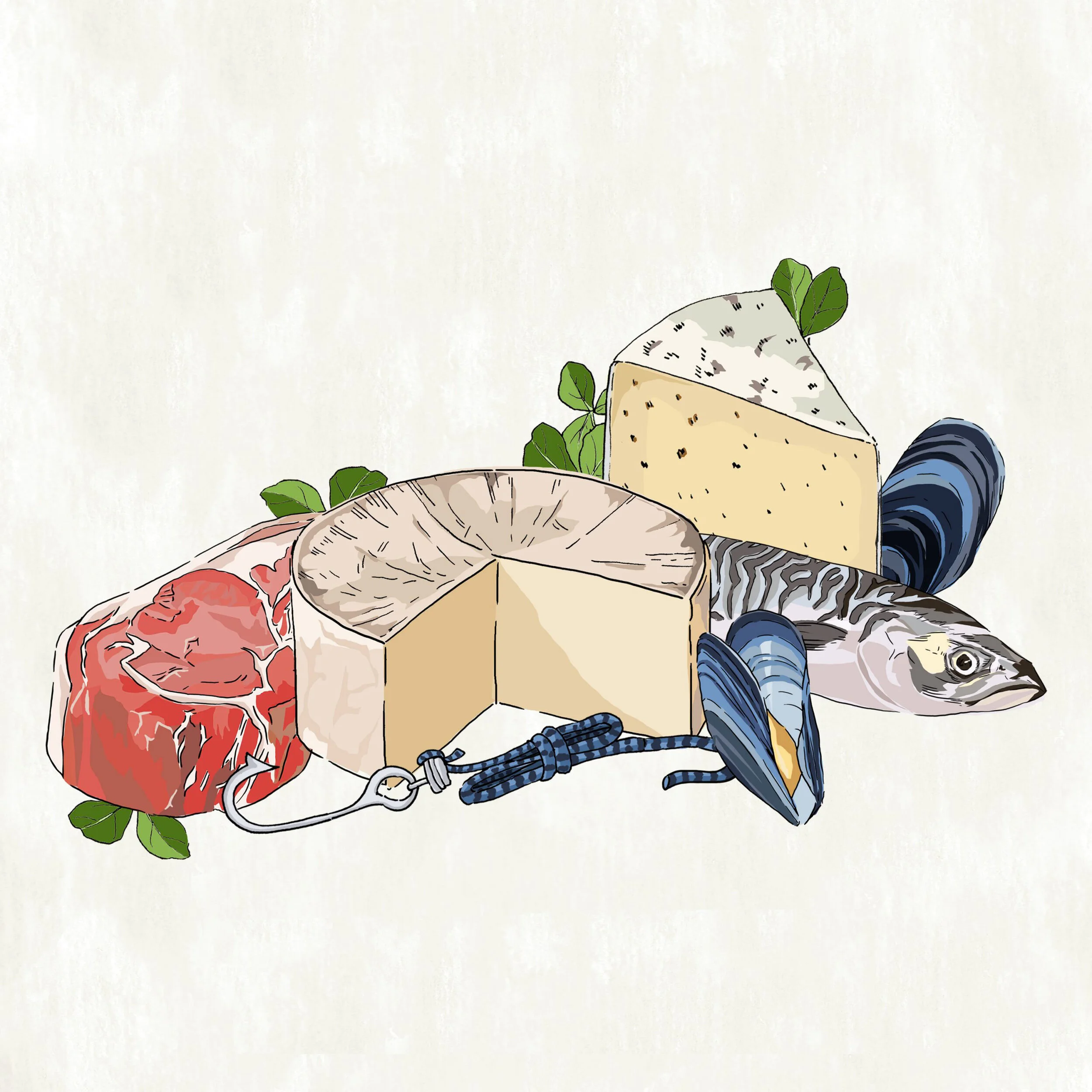
Episode #2 asks how the pandemic has changed the people who care for the animals that feed us, exploring how it has impacted their relationships with work and their communities. How have the perspectives of those producing fish, cheese and meat in the UK been affected by their experiences of the pandemic, and how are they adapting to life in lockdown?

First crossing the Irish Sea to Ballylisk in County Armagh, Northern Ireland, we meet Dean Wright, a dairy farmer and cheese-maker who began to deliver milk and other artisan products to his local community at the onset of lockdown. Heading to Wales, we hear from Muhsen Hassanin, a smallholder and halal slaughter-man who provides regeneratively farmed meat to Muslims across the UK. And lastly, we meet John Martin Tulloch, a fishmonger in the Shetland Isles who lost his international market, but fortunately found a new customer base much closer to home.


Ep-3-scaled.jpg

Who Feeds Us? #3: Growing Our Own

As supermarkets struggled to restock fruit and veg, the idea of ‘growing your own’ took on new significance. To grow your own food, the first thing you need are seeds. For centuries farmers saved their seeds, which adapted to their environments and created local varieties. With the development of commercial seeds that can’t be harvested or re-sown, crops grew less resilient and sustainable. Now, by preserving open-pollinated seeds, communities around the world are helping to ensure their own food security in the face of a climate crisis as well as the current pandemic.

Episode #3 begins in the Midlands, where we hear from Astrid Guillabeau, a Birmingham-based mother who began asking how we can grow our own food in cities. Then it’s over to Walsall-based landworker and founder of No Diggity Gardens, Neville Portas, on the importance of self-sufficiency for his community. In London we hear from Dee Woods, activist and co-founder of Granville Community Kitchen, about the importance of human connection and empowerment through growing food. And lastly, we meet Helene Schulze, a passionate seed saver who tells us why seed sovereignty is vital for a resilient food future.


Ep-4-scaled.jpg

Who Feeds Us? #4: Whole Meal

When flour became scarce, many who mightn’t usually seek out a local bakery, let alone a local mill, started to do just that. In episode #4 we find out how this sudden upsurge in demand presented a huge challenge for bakers and millers – a challenge met with enthusiasm and ingenuity. Investigating connections between bread, mills, the farms that grow the grain, and the soil in which its grown, learn about the system behind most of the bread eaten in the UK, and the localised, smaller-scale alternatives, which found it could sustain itself during the pandemic.

Hear from Abigail Holsborough, the head miller at Brixton Windmill in South London and at the core of its local community as flour ran low. Meet Rosy Benson, who founded Bristol bakery, Bread and Roses, to provide nourishing loaves to those who needed them most. Then head to a small village in the Highlands of Scotland to hear from Rosie Gray, who set up her bakery, Reviving Foods, in a converted horse-box.


Ep-5-scaled.jpg

Who Feeds Us? #5: Cultivating Abundance

Episode #5 is set in the West Midlands, where it examines how the pandemic has highlighted connections between food, health, community and identity. Learning about the resources and needs of individuals and communities at this time, particularly those of African descent, we ask how access to land and growing space can feed us in different ways, through experiences of abundance and the ability to share in it.

We hear from Lynda Macfarlane, the founder of Vegan Vybes, a community group in Birmingham championing cruelty-free, creative ways of living and communicating. Farmerama collaborator and co-founder of KiondoAndre Reid, shares his story of setting up a WhatsApp group for his community to grow food and become more resilient. And academic, Dr Lisa Palmer, talks about her ‘Digging Around’ project, which researched the long history of African and Caribbean communities in Britain growing food and maintaining connections to their heritage through allotment gardening.

Ep-6-scaled.jpg

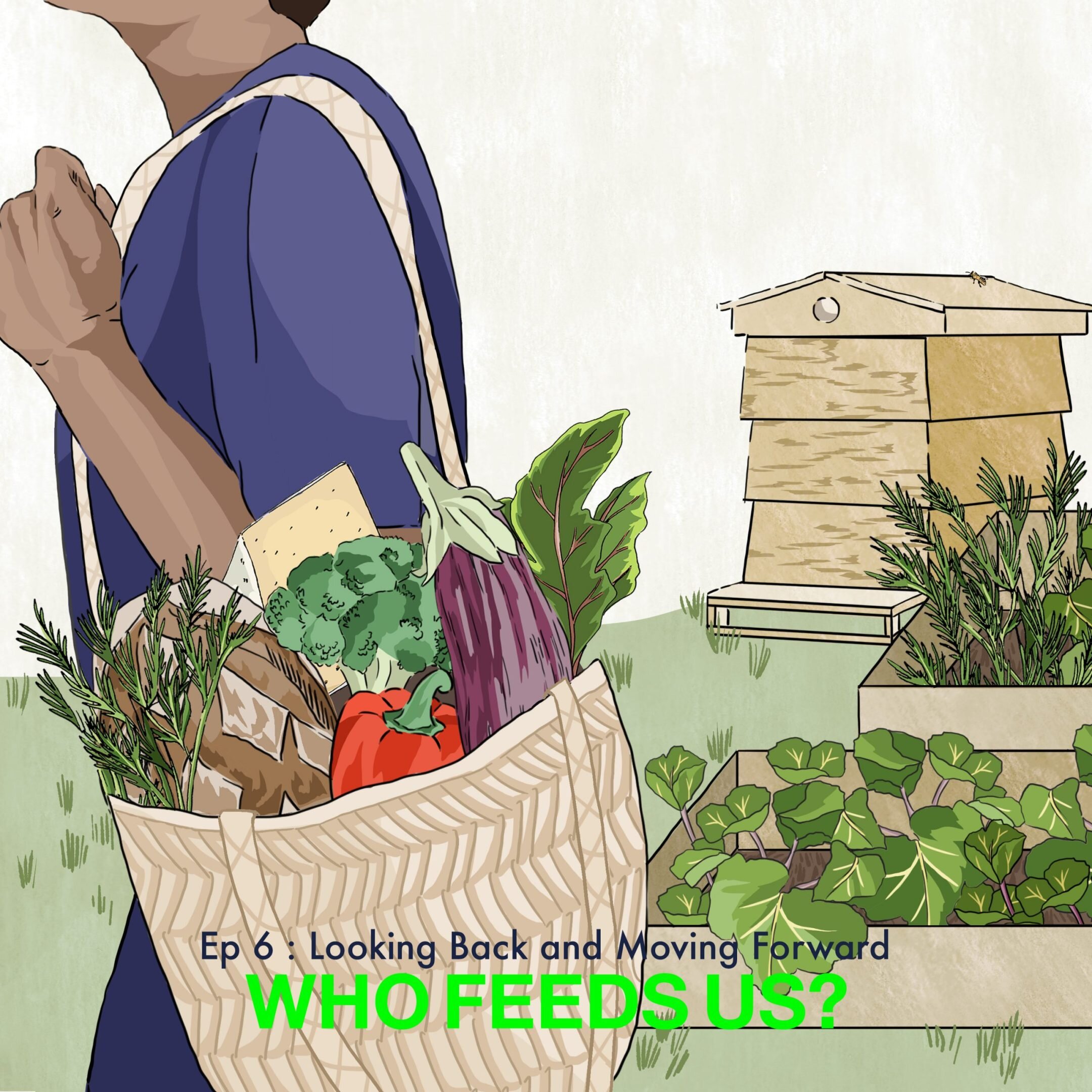
Who Feeds Us? #6: Looking Back and Moving Forward

The final instalment of the series revisits the people introduced in previous episodes, and unravels the common threads that bind these seemingly disparate voices together, such as reverence, gratitude, sovereignty, dignity and abundance. We hear more about they’ve learnt so far this year and their visions for resilient, localised food economies growing into the future.

Food is clearly not just a question of calories; food is nourishment for the body and soul. Food is about community, culture and our relationship with each other and with the Earth. We are all part of the food system.  

The journey towards a truly resilient, humane and nourishing food system is complicated and will most likely be a bumpy one. The series closes with an invitation to embrace that complexity, to dive in, to seek out and connect with those who feed us, because food doesn’t come from shelves, food comes from the soil, the sea, and the hands of people. This is who feeds us.
Dee Woods Interview : Women’s Empowerment and Food Justice

Dee Woods Interview : Women’s Empowerment and Food Justice

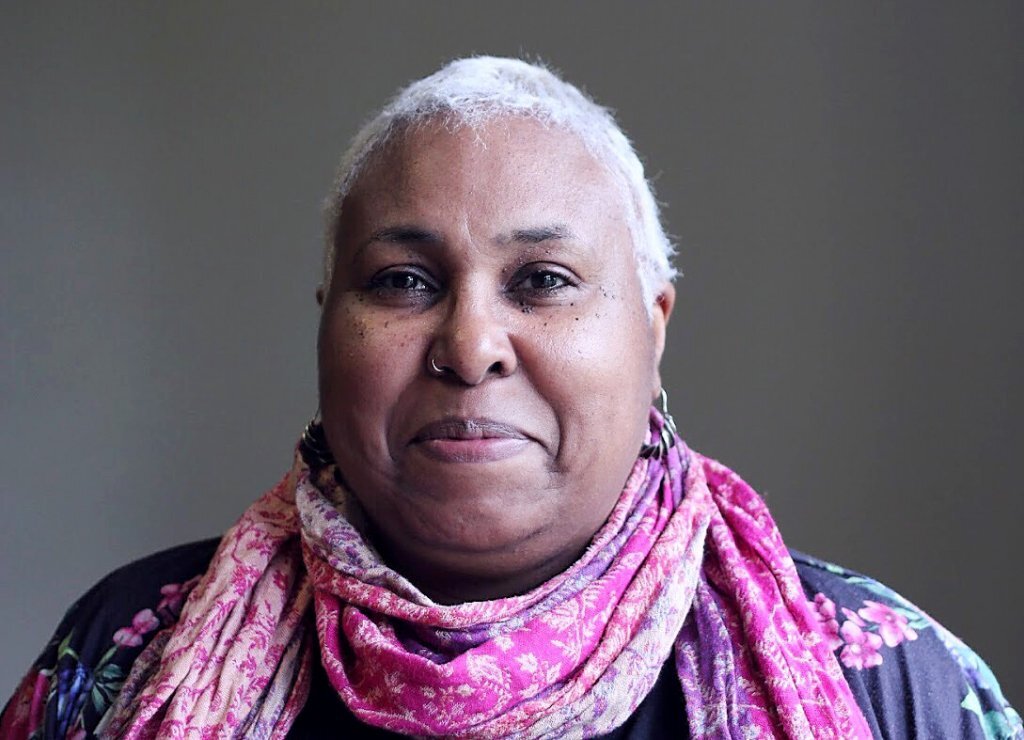
In honour of International Women’s Day, Josina Calliste (co-founder of Land in Our Names - LION) interviewed Dee Woods to get her thoughts on women’s empowerment and food justice. Dee Woods is a food & farming actionist, Landworkers Alliance coordinating group member, and co-founder of Granville Community Kitchen in NW London. 

Dee Woods of Granville Community Kitchen, Kilburn

Dee Woods of Granville Community Kitchen, Kilburn

JC: Thanks for agreeing to have this chat today, Dee. Could you tell me a bit about yourself and your journey into food justice? 

DW: I'm a London girl, born in Ladbroke Grove. I've always been surrounded by food. That influenced a lot of what I do. I moved to the Caribbean when I was young and was immersed in this really diverse food culture. Celebration and connection and community comes with food. Whether we're grieving someone, celebrating their lives, or celebrating someone going on a journey, coming back from a journey… Food is central to everything. So what I do right now, I teach people to cook, in a way that sparks joy and that curiosity to experience flavour and texture and smell and taste. 

Alongside Leslie Barson, I run the Granville Community Kitchen. We co-founded this in 2014 because we could see increasing food inequalities through our own charity work. In our experiences of youth and community work, health promotion, from working really closely with people. 

Granville Community Kitchen was born through drawing on my experience as a food grower from a farming background and aspiring to be back on the farm (laughs), coming from a strong community. I’d experienced food insecurity because of disability benefit decisions and literally not having any money. Having to decide What do I do? Do I pay bills? Do I eat? Do I feed my children? And seeing that happen with other people, I thought there must be a better way to do this. 

JC: It’s great you brought up the celebratory nature of food in the Caribbean, alongside the harsh realities of austerity and disability benefit decisions and what it's done to people's lives, and the need for food justice in inner-city areas. What does a feminist food struggle look like to you? 

DW: In the 80s, I worked to create spaces for women of colour using womanist, black feminist perspectives. We created spaces where people could heal and get mental health support from other women of colour. 

For me, it's important to have that lens - feminism needs to be intersectional in food justice. One that focuses on our intersectionality of race, gender. 

And how food is used as a weapon. So when we talk about food apartheid, it is a militaristic strategy to deny people food. So that you weaken them. When the most affected people are women - especially women of colour. Which is how it fits into a wider white-dominant system. 

A feminist food struggle would have to be one that is queer/gender diverse, centres women, disabled people and people of colour at the centre of organising and co-creating the alternatives.

JC: Whose voices are missing in discussions around the right to food? 

DW: We’re missing the voices of the people most impacted by food insecurity - disabled, elderly and working-class people, women, people of colour, children. Also, people from the north who are greatly impacted by food inequalities, rural voices, including farmers and food producers. 


JC: Who are the women in your communities who inspire you in fighting an unjust food system? 

DW: The elder women inspire me. Because they've made it to their 80s/90s and they come with dignity and so much joy. Even if they might be suffering due to inequality. Firstly the late Beryl Gilroy, writer and teacher,(Paul Gilroy's mother) who was one of the founders of Camden Black Sisters which I was part of from the mid-80s to early 90s. In Trinidad, the late Mrs Nesta Patrick nurtured and guided my feminism as a young woman, giving me my foundation in understanding activism, patriarchy and women's rights.

Two ancestors - my paternal grandmother Elsie Woods nurtured my fascination with food and plants. For a child coming from Ladbroke Grove, she was this wondrous Iyami Aje [1]. My lasting memory of her is walking everywhere with her and foraging herbs and wild plants.  My maternal grandmother Ena Evans and her "sweet hands”[2] sparked my love of cooking (design and fashion) from a very early age.

So I stand on the shoulders of so many great women! I have been truly gifted on my path. And I would say young people inspire me as well. 


JC: Any young women you’re happy to name? 

DW: Where do we start? You! (laughs) 

JC: I haven't done anything!

DW: No really, your passion and deep earth connection along with political astuteness and actionism are truly inspiring. Also Farzana (Khan), Zahra (Dalilah), Guppi (Kaur Bola), Noni (Makuyana)… the list goes on. This generation just gets it. their honesty and authenticity, the profound understanding of interconnectedness, the genuine drive for justice plus the sheer energy and joy… women who understand the systems. From the economy to race, to gender. Women who just know how to unpack these issues, verbalise and explain them to others. 

Dee Woods (left) and Josina Calliste (right)

Dee Woods (left) and Josina Calliste (right)

JC: Wow. Thank you - that is *high praise* for this bunch of young women!

JC: Moving on - we know that 55.9% of food bank users are women, and a disproportionate number of those are Black & Asian women. Can you tell me a bit more about this? 

DW: Here in the UK, particularly in urban settings, we see the inequality in women's lives. Particularly for women of colour. Poverty, disability, food insecurity, health inequalities, poor housing all play a role. It is a struggle to see and hear about people’s lives, as someone with those lived experiences and also on the frontlines of a worsening food insecurity crisis.  It makes me angry that in the 6th richest economy that this is allowed to happen.

Current research is beginning to show who is most impacted, but there is no real analysis as to why. We need an intersectional lens that centres race, gender, class, sexuality and ability. Top-down and policy responses take time. So we have a collective responsibility to create grassroots solutions whilst lobbying for the systemic change. The voices of those most affected must be centred in both policy and grassroots solutions. 

JC: How does Granville Community Kitchen try to empower women, address food poverty & address the things that contribute towards foodbank use? 

DW: I think what we do is encourage women to step into their power by supporting them. Because I often say that Granville Community Kitchen is a centre for resistance, resilience and repair. So by supporting women like that - some people have gone on to work, some people have gone on to study, be it a short course or something. Other women just volunteer because that's all they can do. But they know they are part of something and they're contributing and making something.  And I think our particular model of community working is because we're community-owned. We're not a charity, we're not a social enterprise, come in to solve a problem - no. This is a community sitting down together and working out what we can do to support each other. 

Women are leaders within this. But we need to be in the places where decisions are made, and we need to be upskilling to get ourselves there. When I say upskilling - we need to be learning policy-speak and learning how to write it. Being able to read, draw out facts, learn research skills, and share our stories, our personal experiences. We hold the power to change narratives. So, poverty isn't a crime, it's nothing to be ashamed of, because we're not poor because of our choices, we're poor because there's a system stacked up against us.


JC: Yes that’s not intuitively feminist to me. It’s not how I’ve seen women work together - or what I imagine my Grenadian Grandmother did, or the grandmothers you talked about in this interview… 

DW: Caribbean society is heavily matriarchal. Women did things - market, su-su, they were the ones organising and running things. Still burning a pot, still baking bread, still out in the fields. Women were the ones thinking, organising, writing. Being in the kitchen - that is powerful. Understanding food, being able to cook - that's transformative. Knowing how to grow food - that is knowledge. If you don't know that and you don't know how to pass that on - you know nothing.  


 JC: Final question - how do we build solidarity and movements for our collective liberation? 

DW: We need more people from our communities stepping up. That is happening within faith groups around food banks. But we need more of a food justice, food sovereignty dynamic. This would mean setting up projects which support people into work, to build skills and address their issues. We need to truly listen and to have the courage to do the often painful work in our communities. To not only tear down the edifices of oppression, but do the healing work and build alternatives that are just and equitable. To find common ground is to honour our human dignity and to centre everything in love.


*.1 Iyami Aje (Yoruba): Obeah woman or witch

*.2 Sweet hands: a term from Trinidad & Tobago for someone who can transform the simplest of ingredients into something that is divinely gastronomic, evoking pleasure and memories of good food. See here: https://www.stabroeknews.com/2015/10/17/the-scene/tastes-like-home/sweet-hands

*.3  su-su (original Yoruba - esesu)  - informal rotating savings networks popular among women in African diaspora communities. Other names include: tanda, pardner, box hand, stokvel, hagbad, ayuuto.

Header Image Credit : Miles Willis Photography


Author: Josina Calliste,
LAND IN OUR NAMES (LION)

Josina is a health professional, landworker, activist and community organiser. She co-founded Land in Our Names (LION) in June 2019 in order to uproot & disrupt systemic issues of land as they pertain to people of colour in Britain. She loves farming and nature walks. One day she will found an eco-village with anti-racism and women's empowerment at its heart.

You can contact Josina via:

Insta: @LandInOurNames / @Josinaz13.8
Twitter: @Jo_ZinaC